
START HERE
Pick what you race, then do gearing, battery, and ripple — in that order.
HOW YOU START
Same order for everyone: gearing first, then battery, then ripple. A beginner needs a plain explanation of what 4S means before those tools. A seasoned racer can skip the baby steps and still should not jump straight to ripple.
Ripple matters; it is just not the first question most people walk in with. They want to know how to gear the car so it doesn't grenade, then whether the pack can hold it.
If you're new, you should really scroll down a little and get familiar first.
If you already know what you're doing and just want the gearing calculator, start here.
Something already broke? Go to What Went Wrong?
WHAT YOU'RE DOING
| Style | How long it's under load | What to watch |
|---|---|---|
| Drag | A few seconds. Hard launch, then the pass is over. | Sag, a brief hit of ripple. |
| Speed run | The whole straight. You linger at part throttle, then go wide open. | Ripple, switching heat, eddy currents, stator heat. |
| Truck pull | The length of the pull. Starts hard and gets heavier; it never lightens up. | Sustained high load and heat. |
| Boat | Minutes on the pipe. Like a speed run, held wide open much longer. | Same as a speed run, plus the duration. |
| Basher | The whole session, in punches. Jumps, flips, and field blasts — hard hits over and over, not one clean pass. | Repeated punch current, sag, ripple at part throttle, and heat that piles up because he doesn't stop after one run. |
| 1/5 & 1/7 scale | The whole session, and the truck is heavy. 12S and a 60 mm motor move a lot of mass, so the load stays on. | Voltage match (12S), gearing that the big motor and drivetrain can live with, sag on punch, ripple, and heat that soaks in because nothing about this is over in three seconds. |
A truck pull is closer to a drag race than to a speed run, except the sled gets heavier as you go. A boat is a useful comparison for a speed run: both stay on the pipe instead of being done in a couple of seconds. A basher is not racing a clock, but the truck still sees launch-level hits again and again, plus long stretches across a field at part throttle. A 1/5 or 1/7 on 12S is its own world: more cells, a bigger can, and a heavier car, so everything you already learned still applies, just scaled up.
HOW THE LOAD DIFFERS
Teaching sketch of relative load through a typical run — illustrative, not measured data from any car. 100 is as hard as that run gets, not a real amp number.
Drag spikes and then it's over. A speed run climbs through the mid-throttle range and then stays high. A truck pull starts under load and gets heavier all the way to the end. A boat rises onto the pipe and stays there for minutes. A basher punches, settles, and punches again for the whole session. A 1/5 or 1/7 stays under load because there is a lot of truck to move, and a 60 mm motor on 12S will keep asking for current.
TIME IN THE RIPPLE BAND
Teaching sketch of how long a typical run spends around 35% to 70% throttle, where the ESC is switching the hardest. Illustrative, not measured data.
Ripple voltage is worst in that mid-throttle band, not after the ESC is fully on. A drag car blows through it. A speed-run car lives in it while it is still gaining speed. A basher spends plenty of time in that band while he cruises and sets up the next punch, then slams the trigger again. Big-scale 12S ESCs still spend time in that 35% to 70% band too, and the switching heat plus the mass means the session is long enough to matter. That is why speed-run, boat, and bash people need to understand ripple and ESC switching more than a first-time drag racer does.
FROM THE PACK TO THE WINDING
The loads above run through this circuit. A DC pack feeds a DC bus, with ripple caps across it. Six FETs chop that bus into pulsed three-phase and send it down three leads to the stator. Battery current is on the left of the FETs — the number most logs show. Phase current is on the right — the current that heats the copper. The dashed line is position only: it tells the ESC where the rotor is; it does not carry power or turn the motor.
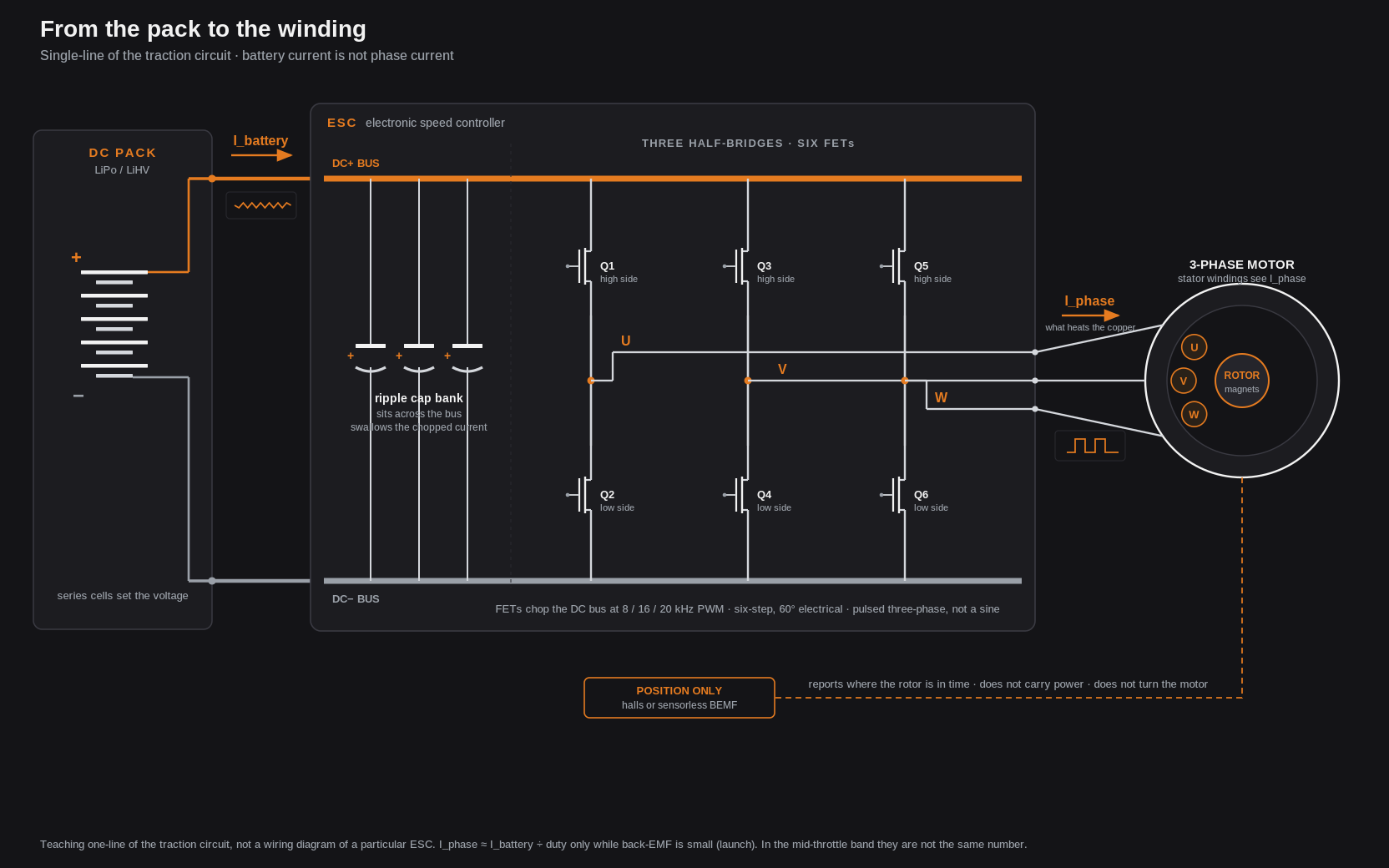
Teaching one-line of the traction circuit, not a wiring diagram of a particular ESC. Scroll sideways to read the one-line.
THE PATH
PICK WHAT YOU ARE DOING
Drag, speed run, truck pull, boat, basher, or a 1/5 or 1/7 scale car. The order of the tools stays the same. What you have to watch changes.
GEARING
This is the first real question. Pinion, spur, and the rest of the drive set motor speed and load. Get this wrong and you smoke parts before ripple ever gets a vote.
BATTERY
How many cells in series (S) sets voltage. How many in parallel (P) is what keeps the pack from falling on its face. Match S to what the ESC and motor can take, then size parallel for the load.
RIPPLE
The caps at the ESC take the high-frequency hit at part throttle. After gearing and battery make sense, this is how you keep the ESC from cooking — especially on a speed run or a boat.
NEVER OWNED AN RC?
S is how many cells are stacked in series. That stack is the pack voltage. Each LiPo cell is about 3.7 V resting and 4.2 V fresh off the charger.
- 4S is four cells in series: about 14.8 V resting and 16.8 V full.
- 6S is about 22.2 V resting and 25.2 V full.
- 8S is about 29.6 V resting and 33.6 V full.
- 12S is about 44.4 V resting and 50.4 V full.
Your ESC and motor have to be rated for that voltage. Buying a 4S pack for an ESC that only takes 3S is how beginners let the smoke out on day one. After you know your S count, go to gearing, then battery in parallel, then ripple.
ALREADY RACE?
You can skip the voltage lesson and still start at gearing, then battery, then ripple. Plenty of people buy a cap pack because a buddy has one, without knowing why. The ripple calculator is how you learn why, and whether you actually need what you copied.
On a normal first setup and sane gearing, ripple often stays inside what a modern ESC can live with. It becomes the thing that cooks equipment when you start pushing, or when you spend a long time at part throttle.
SPEED RUNS & BOATS
These two need extra attention after gearing and battery, because the run stays in the danger zone long enough for heat to pile up.
- If the ESC lets you raise switching frequency, set it as high as it will go. Higher frequency cuts ripple.
- Understand that 35% to about 70% throttle is where the ESC works hardest. A speed run spends a lot of time there while the car is still gaining speed.
- Eddy currents and thermal saturation in the stator show up on a long pass. A drag run is often over before the motor soaks through. A speed run or a boat on the pipe is not.
- The XC-ESC can show phase current to the motor, which most ESCs do not. Battery current is what leaves the pack. Phase current is what the windings actually see, and that is what you use to estimate the motor's thermal reservoir and dial a setup instead of guessing after a cooked stator.
IF YOU BASH
This is the dude who runs 6S on an X-Maxx, does flips, and goes across a field as fast as he can. He generally beats the living hell out of these things. There are a lot of bashers out there, and gearing, battery, and ripple all matter to him too. Same order: gearing, then battery, then ripple.
- Gearing: stock bash trucks get cooked when someone slaps a hotter motor or taller pinion on and keeps jumping them. Gear it so the motor and drivetrain can live through the abuse, not just so it feels fast in the grass.
- Battery: 6S on something like an X-Maxx is a real voltage and current jump. Match S to what the ESC and motor are actually rated for. Parallel and pack quality still matter, because repeated punches sag a weak pack the same way a drag launch does.
- Ripple: bashers live at part throttle between punches and then hammer it. That mid-throttle band is where the ESC works hardest, and a long bash session is plenty of time to cook an ESC that would have survived a few short drag passes.
- Heat: unlike a 3-second drag pass, a basher keeps going. Eddy currents and thermal saturation show up when you don't let the system cool.
1/5 AND 1/7 SCALE
12S ESCs and 60 mm motors are a different league than a 6S 1/10 or a short drag pass. People bash these and people run them for speed, and both happen in this class. Same order: gearing, then battery, then ripple.
- Gearing: a 60 mm motor has a lot of torque. The wrong pinion still grenades diffs, cups, and the motor itself. Gear it so the big can can live, not just so the truck feels violent.
- Battery: 12S is about 44.4 V resting and 50.4 V full. The ESC and motor have to be rated for that. Parallel still matters, because a heavy 1/5 punching across a field will sag a weak pack.
- Ripple: 12S switching is a real stress on the ESC. Mid-throttle is still where ripple is worst, and these sessions last.
- Heat: more copper, more mass, more time. Eddy currents and thermal saturation in a 60 mm stator show up when you keep using it. Let it cool, and do not treat it like a three-second drag motor.
THE TOOLS
The calculators lean drag today. A speed-run flavor may come later, so the 200 mph crowd isn't handed only a 132-foot drag story.